
With the official rollout of the EU's regulatory ban on Bisphenol A (BPA), BPA-free packaging has become a core market access requirement for food contact materials worldwide. Many end brands have listed BPA-free compliance as a mandatory criterion for supplier screening. Faced with increasingly stringent global regulatory standards, have relevant enterprises fully prepared themselves?
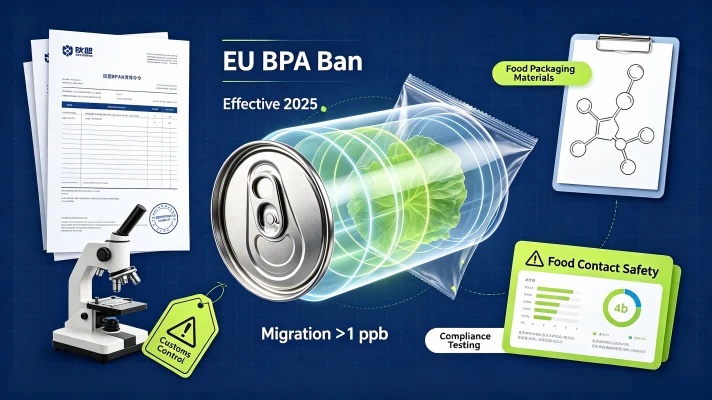
The European Commission previously issued a landmark regulatory rule, stipulating a comprehensive ban on the use of BPA in all food contact materials effective January 20, 2025, accompanied by an 18-month transition period that officially ended on July 20 this year. Once the transition period expired, any regular metal cans and tray, glasses or plastic bottle,plastic tray and container, laminated flexible packaging exported to the EU market, including beverage cans and standard food packaging, will face customs detention, return shipments and substantial financial penalties if BPA migration exceeding the limit of 1 ppb is detected.
Regulatory tightening is not limited to the EU. The US FDA food contact material standards and China's GB 4806.10 standard will both implement stricter updated regulations in 2026, forming a landscape of converging rigorous standards across the world's three major markets. Mandatory policy requirements are pushing end brands and upstream & downstream packaging manufacturers to accelerate product iteration and technological upgrades.
Why Is BPA Subject to Strict Global Regulation?
Bisphenol A (BPA) is a core raw material for epoxy resin synthesis. Thanks to its outstanding corrosion resistance, strong adhesion and stable high-temperature resistance, epoxy resin has long been widely adopted as an anti-corrosion inner coating for metal cans. It acts as a barrier separating metal cans from food and beverages, preventing metal corrosion and undesirable flavor changes in food products.
Despite its excellent industrial performance, BPA carries endocrine-disrupting properties. With prolonged contact with food, BPA may migrate into food items, posing potential hazards to human health. For this reason, BPA has been listed as a high-priority chemical for supervision and restriction across the globe.
The BPA-Free Era: How Can Packaging Manufacturers Pursue Upgrades?
Safety standards for food contact materials keep tightening globally, and "BPA-Free" has turned into a core assessment metric for brands selecting metal packaging suppliers. Data from market research firm QYR indicates rapid expansion of the global BPA-free coating market. The market size is projected to reach USD 202 million by 2032, with a compound annual growth rate (CAGR) of 7.58% from 2026 to 2032. Driven by mandatory policies and market demand, metal packaging manufacturers and supporting coating suppliers need to accelerate strategic layout by focusing on three core directions to seize new opportunities for industrial upgrading.
1. Select Alternative Materials: Balance Safety and Functional Performance
Traditional BPA coatings deliver remarkable performance in corrosion resistance, adhesion, flexibility and thermal stability. Alternative materials must eliminate health risks without compromising these key functional properties. Common eco-friendly options such as acrylic and polyester materials meet basic safety standards yet present obvious drawbacks in chemical resistance and impact resistance, which may lead to coating peeling and can corrosion, failing to meet long-term food packaging demands.
TMBPF (Tetramethylbisphenol F) epoxy resin materials optimized via molecular structure design offer a viable industrial solution. Structurally engineered to avoid endocrine-disrupting risks, they retain corrosion resistance and thermal stability comparable to conventional BPA coatings, striking a balance between safety and practical performance.
2. Match Existing Production Lines: Seamless Process Compatibility to Cut Renovation Costs
Metal can production lines today feature highly standardized coating and curing workflows. New BPA-free coatings must seamlessly integrate with existing equipment and processes while maintaining consistent packaging appearance and protective performance, minimizing costly large-scale production line renovations.
High-performance Bisphenol-free inner coating technology for beverage cans caters to this exact demand. Free of bisphenol substances, styrene, PFAS and formaldehyde, such coating systems can be directly applied to current production lines without extensive equipment adjustments. They shorten production cycles and optimize finished product quality, holding certifications from authoritative food safety regulators including the US FDA and fully complying with the latest EU regulations.
3. Strengthen Printing Control: Avoid Hidden BPA Risks in Inks While Preserving Premium Visual Quality
Many packaging manufacturers hold a misconception that BPA supervision only applies to inner coatings and excludes printing inks. In fact, the latest EU regulations explicitly include food packaging printing inks within the scope of core supervision, establishing full-chain oversight covering both coatings and printing processes.
Conventional UV and LED curable inks often contain hidden bisphenol compounds added to boost adhesion and stability. These substances evade routine testing and frequently trigger excess BPA residue and migration issues. On the other hand, certain BPA-free inks that satisfy safety criteria suffer from slow curing speed, weak adhesion, low color saturation and poor weather resistance, failing to meet brands' high visual standards for packaging. Therefore, all-scenario ink solutions featuring 100% BPA-free formulation, food-contact safety and superior printing performance will become an essential industry necessity in the future.
A Critical Window for Industrial Upgrading Opens, Ushering in a New Era of Green Packaging
Against the backdrop of fully enforced BPA bans and tightening global regulations, Haide Pack supply chain has entered a vital window for product and technological upgrades. As a professional industry leader in flexible packaging, Haide Pack update the chemical supplier DIC/Sunchemical, Henkel, Bostik etc. with advance BPA-free solution and technology iteration and jointly drive the compliance and sustainable upgrade of the industrial packaging solution to be updated accordingly.