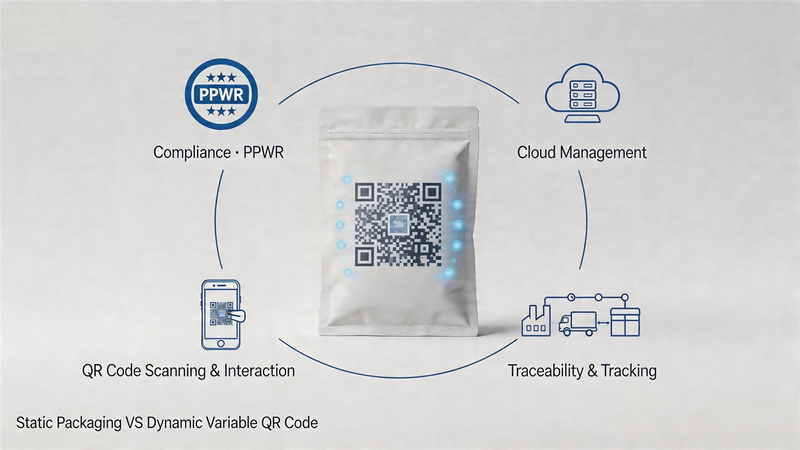

Printing variable QR codes on flexible packaging-where each individual pouch or sachet carries a unique, changing QR code-is rapidly transitioning from a "premium option" to an industry standard. This technology transforms every flexible packaging unit into a unique digital portal, bridging the physical product with the digital world.
1. What is Variable Data Printing?
Variable Data Printing (VDP) is a digital printing technology that allows elements such as text, graphics, or images to be changed from one label to the next without stopping or slowing down the press, enabling mass customization of labels.
For flexible packaging, this means producing pouches where each unit carries a unique QR code-each code can be an individual serial number, traceability code, or consumer engagement portal.
2. Key Drivers: Why Now?
Several forces are accelerating the adoption of variable QR codes on flexible packaging:
|
Driver |
Specifics |
|
Regulatory Compliance (PPWR) |
EU PPWR requires QR codes on reusable packaging (by 2029) with information on reuse systems and collection points; harmonized labels with QR codes for product/disposal information |
|
Global QR Migration |
GS1's "Sunrise 2027" initiative: 1D barcodes will be progressively replaced by 2D codes at POS; China has already published a group standard for variable QR printing on food flexible packaging |
|
Supply Chain Transparency |
Brands need to meet increasingly stringent traceability requirements; each packaging unit can be tracked independently |
|
Consumer Engagement |
Variable QR codes serve as direct-to-consumer interaction portals-scan for product tracking, loyalty programs, product information |
|
Brand Protection |
Unique digital product identifiers enable anti-counterfeiting and brand protection |
3. Technology Implementation Methods
Several technical approaches enable variable QR code printing on flexible packaging:
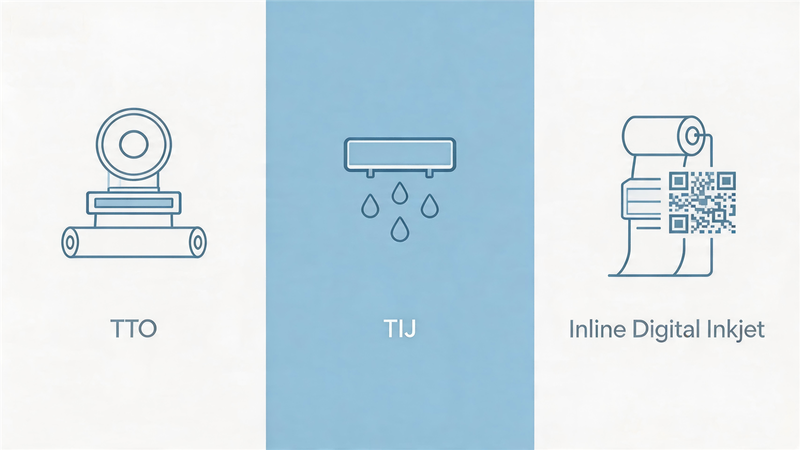
3.1 Thermal Transfer Overprinting (TTO) – Mainstream Solution
Working Principle: An ink-coated ribbon passes under a heated print head; ink melts and transfers onto the packaging substrate.
Advantages:
High-resolution printing with excellent contrast and readability
Speed unaffected by code size-maintains constant line speed even when printing large or complex codes
Suitable for various flexible films, non-woven materials, and other substrates
Applications: Integrated with vertical/horizontal form-fill-seal (FFS) machines, printing during pouch formation
3.2 Thermal Inkjet (TIJ)
Working Principle: Micro-resistors in the print head heat the ink, creating bubbles that eject ink droplets onto the substrate.
Advantages:
Non-contact printing
Low maintenance (print head in cartridge)
Up to 600×600 dpi resolution
Minimal waste (no ribbon consumption)
Applications: Environments requiring low maintenance and flexible changeovers
3.3 Digital Inkjet Integration (Inline/Nearline)
Notable Examples:
Domino K-Series: Up to 600 dpi resolution, speeds up to 250 m/min; deployed for wine labels, premium packaging
Esko Automation Engine + Scantrust Integration: Automatically generates serialized QR codes within packaging design workflow, supporting small/medium batches to industrial-scale production
ePac's ePacConnect Service: Unique Scantrust QR code on each flexible pouch, enabling anti-counterfeiting protection and supply chain traceability
3.4 Digital Foil Imprinting
Application: Premium applications requiring metallic-effect variable codes-limited editions, personalized packaging
4. Typical Application Scenarios
|
Application |
Description |
|
Anti-Counterfeiting & Brand Protection |
Unique code on each package verifies authenticity, prevents counterfeiting |
|
End-to-End Traceability |
Complete tracking from production to end consumer; each package traceable independently |
|
Consumer Engagement |
Scan to access brand campaigns, participate in lucky draws, obtain product information |
|
A/B Testing & Market Insights |
Scan data from different package variants quickly reveals consumer preferences |
|
Dynamic Content Updates |
QR code content can be updated in real-time without changing the physical package-ideal for regulatory changes, recycling information updates |
|
Regulatory Disclosure |
Meeting PPWR and other法规 requirements for digital labeling |
5. Dynamic QR Codes: Beyond "Static Printing"
The true frontier is Dynamic QR Codes:
Once printed on the package, brand owners can update the content behind that code at any time via a cloud platform-whether modifying the landing page URL, updating product information, or adding compliance documents-without changing the physical packaging.
Strategic Value:
Regulatory Agility: When PPWR requires updated recycling标识 or substance disclosure information, a后台 update takes effect immediately
Cost Savings: Avoid scrapping already-printed packaging materials due to information changes
Long-Term Applicability: One package can serve multiple marketing campaigns; content changes as needed
Technical Prerequisite: Requires QR code to link with a cloud-based content management platform (e.g., Buyerdock + Domino combination)
6. Quality Assurance & Standards
Chinese Standard: Guidelines for Variable QR Code Printing on Polyethylene/Polypropylene Products for Food Flexible Packaging (T/AHNY 1-2025) has passed technical review, covering:
Code assignment design
Printing process
Data verification and security
Data application
Printing quality inspection methods
International Compliance:
GS1 Digital Link standard support
PPWR's specific requirements for QR codes
7. Recommendations for Flexible Packaging Manufacturers
Equipment Investment Direction: Evaluate TTO or digital inkjet integration solutions; select appropriate technology based on target customer segments (pet food, food, pharmaceutical) and their needs
Software Capability Development: Variable code printing is not just a hardware issue-requires software for data generation, management, and verification
Collaboration with Brand Customers: Help customers understand the value of dynamic QR codes; provide one-stop service from packaging design to data platform integration
Regulatory Anticipation: Monitor PPWR 2026–2028 timeline; proactively build QR code printing capabilities that meet regulatory requirements
8. Comparison Summary
|
Dimension |
Traditional Static Packaging |
Variable QR Code Packaging |
|
Information Carriage |
Fixed once printed |
Unique per unit, content dynamically updatable |
|
Consumer Engagement |
One-way |
Two-way, trackable |
|
Anti-Counterfeiting Capability |
Weak |
Strong (unique serial number) |
|
Regulatory Adaptability |
Changes require new printing plates |
Background updates possible |
|
Production Complexity |
Low |
Medium-high (requires VDP capability) |
|
Investment Threshold |
Low |
Requires specialized equipment & software |
Summary
For flexible packaging companies serving the EU market (where PPWR mandates QR codes) or premium brand customers, building variable QR code printing capability is no longer a "nice-to-have" but a market access necessity.
The combination of variable QR codes with dynamic content management offers a powerful solution for regulatory compliance, consumer engagement, and operational efficiency-all while keeping the physical package unchanged.