



In the era of stricter environmental compliance, upgraded market demand, and cost‑efficiency priorities, the flexible packaging industry is undergoing a technology-driven transformation centered on sustainability, functionality, and cost optimization. Beyond environmental performance, high-temperature retort packaging increasingly demands superior heat resistance, flatness, easy-opening, and other functional properties to enhance product value and user experience.
Against fierce market competition, cost control has become essential for business growth. Through technological innovation, manufacturers can balance environmental protection, functionality, and cost, strengthening long-term competitiveness.
Based on our company's R&D and practical experience in high-temperature retort CPP films, combined with emerging industry needs and trends, this article shares advances in retort packaging technologies across five areas: printing, lamination, film structure, thickness reduction, and functional upgrading. With real application cases, it interprets development directions to support industry-wide progress.
1 Advances in New Technologies for High-Temperature Retort Packaging
1.1 Innovation in Printing Technology: The Rise of Water-Based Inks
Traditional flexible packaging printing relies heavily on solvent-based inks, which bring high VOC emissions, residual solvent risks, and heavy compliance pressure. In recent years, water-based printing technology has gained wide attention for its ultra-low VOCs, zero solvent residues, and enhanced safety.
Although early water-based inks were weaker in adhesion, heat resistance, and media resistance, continuous upgrades in waterborne resin systems, crosslinking technologies, and formulations have greatly improved high-performance retort-grade water-based inks. Their adhesion, rub resistance, retort stability, and lamination compatibility now meet industrial requirements.
Some Chinese flexible packaging enterprises have piloted high-grade retort water-based inks, and a few have achieved stable small-batch mass production. Compared with solvent-based inks, they significantly reduce VOCs and energy consumption, supporting low-carbon, safe, and regulatory-compliant production - a key direction for green transformation.
Case Study
A northern packaging plant uses WPU (waterborne polyurethane) inks to produce 121°C retort pouches for prepared meals, instant rice, and soft canned food.
Substrate: PET 12 μm
Equipment: Modified gravure dryer for thorough water-based ink curing
Speed: 230–240 m/min
Diluent: 75% ethanol + 25% water
Result: Passed 121°C/30 min retort test with clear patterns, no ink detachment, and stable lamination strength. Now used for EU export orders.
1.2 Upgraded Lamination Technology: Solvent-Free Adhesives for Retort
Adhesives determine lamination strength, heat resistance, and environmental performance. Traditional solvent-based adhesives involve VOCs and residual solvents. While solvent-free adhesives are eco-friendly and efficient, early grades faced issues such as delamination, poor heat resistance, and weak resistance to oil or acid in retort conditions.
Recent technological breakthroughs have enabled solvent-free adhesives to perform reliably under harsh retort conditions. Key improvements include:
Enhanced heat resistance: Modified two-component polyurethane adhesives with nano-silica, siloxanes, or polycaprolactone polyols support stable performance up to 135°C, with strength retention >95% after retorting.
Functional expansion: Special grades resist oil, acid, alkali, and offer high barrier properties for sauces, meat, military rations, and medical sterilization packaging.
Superior environmental performance: Nearly 100% solid content, zero VOCs, no drying required, higher production efficiency.
Case Study
A converter replaced solvent-based adhesives with retort-grade solvent-free adhesives to meet EU export standards and reduce emissions.
Products: Prepared meals, instant rice, canned fish, rice dumplings
Structures:
PET 12 μm / AL 7–9 μm / NY 15 μm / RCPP 70–80 μm (aluminum high-barrier)
High-barrier PET 12 μm / NY 15–20 μm / RCPP 70–80 μm (transparent high-barrier)
Lamination: 5-roll solvent-free coater, 1.8–2.2 g/m² coat weight, 220–300 m/min
Curing: 48°C × 48 h (121°C grade); 55°C × 72 h (135°C grade)
Result: Stable lamination, no delamination or bubbles after retorting; used in large-scale production.
1.3 Innovative Film Structures: Aluminum-Free & Mono-Material Solutions
Traditional retort packaging often uses plastic‑aluminum laminates for barrier performance. However, aluminum is non-recyclable, carbon-intensive, and difficult to separate from plastics. Aluminum-free design and mono-material packaging have become core green trends, with RCPP film as a key enabler.
Aluminum-Free Packaging
High-barrier PET and white RCPP films replace aluminum foil while maintaining oxygen, moisture, and light barrier properties. The all-plastic structure is recyclable, lower-cost, and microwaveable.
Case Study
An all-plastic retort pouch for microwaveable instant rice.
Original: PET 12 μm / AL 7 μm / NY 15 μm / RCPP 70 μm
Upgraded: High-barrier PET 12 μm / NY 15 μm / new RCPP 70–80 μm
Result: Meets 6-month shelf life, allows direct microwave heating, reduces packaging cost by 10%.
Mono-Material Packaging
Mono-material (primarily polypropylene/PP) structures simplify recycling by eliminating multi-material separation. Advanced retort-grade CPP films enable stable heat-sealing and high-temperature resistance while ensuring good flatness after sterilization. Many also offer linear easy-tear performance.
Case Study
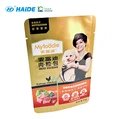
A mono-material retort pouch for pet wet food in Thailand.
Structure: BOPP 19–29 μm / high-barrier BOPP 19 μm / RCPP 60–80 μm
Result: Excellent flatness after 121°C/30 min retorting, comparable to aluminum foil bags; fully recyclable and commercially validated.
1.4 Thinner Films & Cost Reduction via German Extrusion Technology
To improve cost efficiency, film downgauging is widely adopted. However, traditional CPP films often lose performance when thinned.
Using German cast extrusion lines and optimized formulations, our upgraded 135°C retort RCPP film achieves:
Better performance at the same thickness
Equivalent performance at 7–10% reduced thickness
Significantly improved post-retort flatness, eliminating wrinkling and orange peel
Case Study
Chestnut packaging upgraded to 130–135°C retort conditions.
Option 1 (high-end): Same thickness new RCPP for better appearance and stability
Option 2 (cost-effective): 10% thinner RCPP (70 μm → 63 μm) with equal performance
Result: Material cost reduced by ~5%; market share increased significantly.
1.5 Functional Upgrading: Easy-Peel RCPP for Retort
Consumers increasingly demand convenient packaging. Traditional hard-to-open retort lids cause tearing, spillage, and consumer complaints.
Our newly developed easy-peel retort RCPP provides consistent, clean peel performance after 121–125°C sterilization without breakage, hairiness, or residue.
Case Study
Easy-peel lid film for PP food containers.
Structure: PET 12 μm / NY 15 μm / easy-peel RCPP 70 μm
Peel force: 17–20 N/15 mm after retorting
Result: Consumer complaints dropped sharply; sales increased by over 20%.
2 Future Technology Trends
Future development of high-temperature retort flexible packaging will focus on three core directions:
Greening: Wider adoption of aluminum-free, mono-material designs, water-based printing, and solvent-free lamination to meet global recycling and emission regulations.
Functionalization: Tailored materials for heat resistance, oil resistance, acid resistance, easy peel, easy tear, high barrier, and microwave compatibility.
Cost optimization: Further film downgauging, process simplification, and efficiency improvement to maintain performance while lowering costs.
3 Conclusion
Technological iteration in high-temperature retort packaging is driven by both environmental regulations and consumer demand. Modern innovations resolve traditional pain points and achieve a balanced improvement in environmental performance, functionality, and cost efficiency.
Our company will continue to focus on high-performance retort CPP films, promote material and process upgrades, and deliver reliable packaging solutions. We look forward to collaborating with industry partners to accelerate the adoption of green technologies and support the sustainable, high-quality development of the global food packaging industry.