


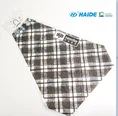

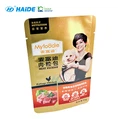
In the field of flexible composite packaging, BOPA film is often used in high-end packaging for food, pharmaceuticals, and other applications due to its excellent barrier properties, high toughness, and good heat resistance. Particularly for high-temperature retort pouches, many clients prefer to use BOPA as the top layer substrate.
However, based on years of production practice and testing experience, Haide Packaging reminds industry peers:
Not all BOPA films are suitable for high-temperature retort environments. Improper material selection may lead to risks such as pouch breakage and easy tearing after retort processing.
I. Two Typical Issues: Performance Degradation of BOPA After Retort Processing
In recent years, Haide Packaging's technical team has received multiple reports regarding quality issues with retort pouches using BOPA as the top layer and has obtained physical samples for analysis. These samples are mostly three-layer structures such as PA/PA/RCPP and primarily exhibit two types of problems:
Type 1: Reduced Transparency and Surface Cracking
- The pouch appears overall whitish with significantly reduced transparency after retort processing.
- Irregular cracks are visible on the pouch body and seal areas under magnification.
- The surface BOPA layer can be scraped off with a fingernail, but the underlying ink layer remains intact.
- This leads to a substantial decrease in the pouch's drop resistance and tear resistance.
Type 2: Excessive Shrinkage and Mechanical Performance Degradation
- No obvious visual changes, but the pouch easily ruptures at non-seal areas under external force.
- Testing shows that after retort processing, the BOPA film exhibits longitudinal shrinkage of 4.2% and transverse shrinkage of 6.67% (national standard requires ≤3%).
- The transverse breaking force decreases from 102N/15mm to 82N/15mm, and the nominal strain at break drops from 47% to 30%.
- Some indicators fall below the requirements of GB/T41168-2021 for three-layer retort pouches.
II. Aging Mechanism of BOPA in High-Temperature Retort Environments
There has long been industry consensus: BOPA is suitable for retort conditions below 115°C. For higher temperatures, it is recommended to use BOPET as the top layer.
This recommendation is based on the aging characteristics of BOPA in high-temperature, humid environments:
1. Thermo-oxidative Aging: Above 120°C, PA materials rapidly lose strength, becoming yellow and brittle.
2. Hydrolytic Degradation: Humid and hot environments accelerate molecular chain breakage, leading to mechanical performance decline.
These two effects occur simultaneously during retort processing, making the aging and degradation of BOPA film nearly unavoidable under high-temperature conditions.
III. Practical Recommendations and Solutions from Haide Packaging
Although not all BOPA films experience severe aging after retort processing, risks do exist. Differences in raw materials and manufacturing processes among suppliers can lead to significant variations in a film's retort resistance.
Therefore, Haide Packaging recommends the following measures:
Strict Pre-testing Procedures
- Conduct simulated retort tests on the intended BOPA film at 121°C or even 135°C.
- Focus on testing changes in the film's tensile modulus, nominal strain at break, and breaking force before and after retort processing.
- Pay attention to thermal shrinkage rates to avoid delamination issues caused by excessive shrinkage.
Establish a Supplier Screening System
- Select film suppliers with experience in producing materials specifically for high-temperature retort applications.
- Require suppliers to provide batch stability data and retort resistance performance reports.
- Avoid material selection based solely on price or general performance indicators.
Provide Reliable Alternative Solutions
For retort conditions of 121°C and above, Haide Packaging typically recommends more robust structural designs:
- PET/PA/CPP: Using BOPET as the outer layer balances strength and barrier properties.
- PET/AL/PA/CPP: Adding an aluminum foil layer for higher barrier requirements.
- Specialized High-Temperature Resistant BOPA: High-stability materials developed in cooperation with specific suppliers.
IV. Building a Systematic Quality Assurance System
Testing a single batch is insufficient to fully mitigate risks. Haide Packaging provides clients with assurance through the following systems:
1. Material Database Development: Accumulate retort test data for different BOPA brands and batches.
2. Application Scenario Classification: Recommend the most suitable structure based on product characteristics, retort temperature, and shelf-life requirements.
3. Production Process Monitoring: Establish critical control points during lamination and curing processes.
4. Finished Product Verification Testing: Sample retort and performance testing for each batch of retort pouches.
Conclusion
Selecting the top layer material for high-temperature retort pouches requires a scientific approach and rigorous procedures. While BOPA offers excellent properties, its stability in high-temperature, humid environments must be verified through systematic testing.
Haide Packaging has years of deep experience in the flexible packaging industry, accumulating extensive knowledge in material applications for high-temperature retort and barrier packaging. We not only help clients identify risks but also provide reliable, validated solutions - guarding packaging quality and safety throughout the entire process, from material selection and structural design to process optimization.
If you are developing or producing high-temperature retort packaging, we welcome you to consult with the Haide Packaging technical team. Let our professional expertise help you avoid material selection pitfalls and create high-quality packaging products that are both safe and cost-effective.