



When Aluminum Foil Gradually Steps Back: The Future of High-Barrier Flexible Food Packaging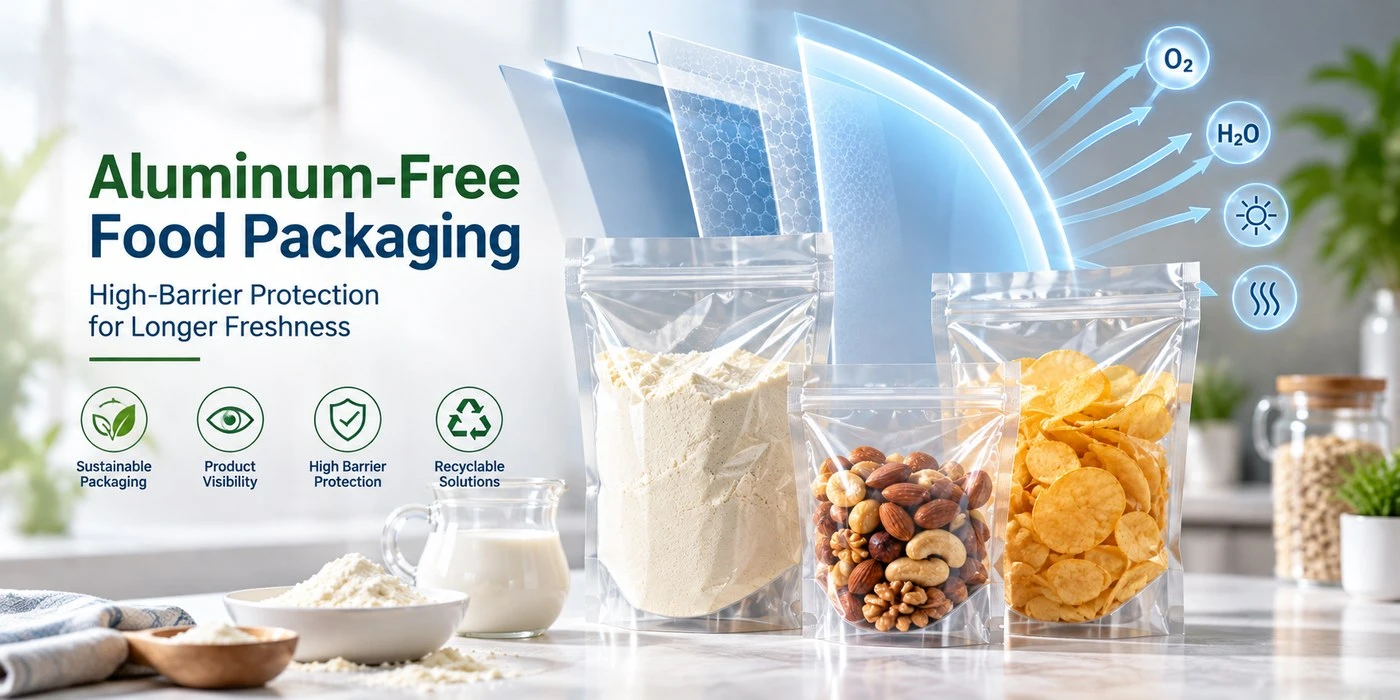
In the field of flexible food packaging, aluminum foil was once synonymous with "absolute barrier performance." A layer of aluminum foil only 6 microns thick can make oxygen and moisture almost unable to penetrate, helping keep potato chips, milk powder, meat products, and other foods fresh.
But today, a profound transformation toward aluminum reduction and aluminum-free food packaging is taking place.
This is not a rejection of aluminum foil. Rather, it is a natural choice for the packaging industry under the trends of environmental protection, material reduction, recyclability, transparency, and more sustainable packaging design.
However, once aluminum foil is removed, how can the barrier performance of food packaging still be guaranteed?
The answer lies in a role that is often overlooked but is extremely important: high-barrier material lamination adhesives.
1. The Strength and Limitations of Aluminum Foil
In traditional flexible food packaging, aluminum foil is often used as an intermediate layer and laminated with materials such as PET, BOPP, and PE.
It is widely used in applications such as milk powder packaging, meat packaging, and retort pouches, where very high barrier performance is required.
Its oxygen transmission rate can be lower than 0.1 cm³/(m²·24h·atm), while its water vapor transmission rate is close to zero. It also provides excellent light protection.
However, aluminum foil is not perfect.
Its production consumes a large amount of energy, laminated structures containing aluminum foil are difficult to recycle, and its relatively poor flexibility can lead to pinholes.
It is also opaque, which prevents consumers from seeing the packaged product, and metal-containing packaging cannot pass through certain metal detection systems.
These disadvantages are becoming increasingly significant under carbon reduction targets and the pressure of the circular economy.
As a result, aluminum reduction is moving from a concept into real action across the flexible food packaging industry.
2. Three Forces Driving Aluminum Reduction
There are three major forces driving the move toward aluminum reduction.
Policy: Packaging regulations in Europe and China's carbon reduction goals are pushing the industry toward better recyclability. Multilayer structures containing aluminum foil can be difficult to separate and recycle.
Industry: Brand owners hope to reduce costs, lower packaging weight, avoid fluctuations in aluminum prices, and meet new application requirements such as microwave heating.
Consumers: Transparent high-barrier packaging is more in line with modern preferences, as consumers increasingly want to see the actual food inside the package.
What truly makes aluminum reduction possible, however, is the development of high-barrier packaging materials and multilayer flexible packaging technologies.
Materials such as EVOH, PVDC, metallized films, and transparent oxide-coated films such as SiOx and AlOx are increasingly being used to replace part of the role traditionally played by aluminum foil.
At Haide Packaging, high-barrier flexible packaging is used in applications where products require protection against oxygen, moisture, aroma, and other external factors. Haide also provides clear high-barrier packaging and transparent retort pouch solutions for food applications where both barrier performance and product visibility are important.
However, these materials each have their own characteristics. To make them work together effectively, one key element is essential: the adhesive.
3. High-Barrier Alternative Materials: Diverse Solutions That Need Adhesive Support
EVOH: Excellent oxygen barrier performance, but sensitive to moisture, so it must be protected between hydrophobic layers.
PVDC: Good oxygen and moisture barrier performance, but it contains chlorine and has relatively poor thermal stability.
Metallized film: Reduces the amount of aluminum to a very thin coating while retaining part of the barrier and light-blocking properties.
Transparent oxide-coated film: Provides high transparency and can be suitable for microwave applications, but the coating may be vulnerable to defects.
The key to aluminum reduction is no longer a single material, but the precise combination of multiple high-barrier flexible packaging materials.
Typical structures may include:
BOPP / EVOH / PE
PET / AlOx-PET / PE
BOPET / EVOH / CPP
At this point, high-barrier material lamination adhesives move from the background to the center of the structure.
4. Lamination Adhesives: The "Invisible Barrier Layer" in the Aluminum-Reduction Era
In the past, laminating aluminum foil with plastic was relatively straightforward.
Because aluminum foil itself is dense and provides excellent barrier performance, the adhesive mainly served a bonding function.
After aluminum reduction, however, packaging structures shift from "metal + plastic" to precise combinations of multiple high-barrier polymers.
The interfaces between layers can become new weak points.
Take EVOH and PE as an example.
EVOH is hydrophilic, while PE is hydrophobic, so the two materials have poor compatibility.
Ordinary adhesives may not provide sufficient interfacial bonding strength.
Under high-temperature retort conditions or high humidity, delamination can occur.
Once delamination happens, moisture may migrate along the interface and reach the EVOH layer, causing it to absorb moisture and sharply reducing its oxygen barrier performance.
Specialized high-barrier lamination adhesives can be designed to form a dense bonding structure at the interface.
They can help reduce moisture migration and slow down the loss of barrier performance caused by EVOH moisture absorption.
In this sense, the adhesive is not only a bonding agent, but also a functional part of the overall high-barrier packaging system.
In transparent oxide-coated structures, the adhesive also needs excellent flexibility and low-stress characteristics to avoid cracking of the barrier coating during lamination or later processing.
In metallized film structures, the acid resistance and chemical resistance of the adhesive can directly affect the adhesion of the metal layer and the long-term stability of the barrier performance.
Without precise matching between the barrier material and the adhesive system, even an excellent barrier film may not perform as expected.
5. Dairy Packaging: A Major Test for Aluminum Reduction
Dairy packaging is one of the most difficult areas for aluminum reduction.
Aseptic liquid dairy packaging, milk powder pouches, and yogurt lids have long relied on aluminum foil.
Dairy products are rich in fats and light-sensitive components, and many require a shelf life of 6 to 24 months.
This creates extremely high requirements for barrier performance and light protection.
In the development of aluminum-free aseptic paper-based packaging, some solutions use high-barrier coated paperboard or EVOH and oxide-coated barrier layers to replace aluminum foil.
However, EVOH performance decreases in high-humidity conditions, while paperboard itself can absorb moisture.
This makes the water resistance and barrier coordination of the adhesive especially important.
A good adhesive can help form a moisture-resistant interface between the paperboard and the barrier layer, slowing the effect of moisture on EVOH.
In milk powder packaging, transparent high-barrier structures such as BOPET / EVOH / PE are attracting increasing attention.
However, the fats in milk powder can affect ordinary adhesive layers, potentially causing delamination and loss of barrier performance.
Therefore, oil resistance and low migration are becoming important technical requirements for high-barrier adhesives used in dairy packaging.
For smaller packages such as yogurt lids and cheese packaging, the balance between easy-peel performance and heat-seal strength is also important.
At the same time, low odor and solvent-free systems are increasingly required to meet food safety expectations.
Haide's transparent retort packaging also reflects this broader development direction. Its clear retort pouch structures are designed for demanding food applications and can support high-temperature processing while combining clear high-barrier performance and product visibility.
6. Challenges and Future Development of Lamination Adhesives
Aluminum reduction still faces many challenges, including the moisture sensitivity of EVOH, defects in transparent barrier coatings, and the barrier performance gap of fully recyclable plastic structures.
High-barrier lamination adhesives must evolve at the same time.
Solvent-free development: Reduce VOC emissions and meet environmental and food safety requirements.
Higher resistance: Improve resistance to retort conditions, oil, acids, and high humidity for more demanding packaging applications.
Functionalization: Provide not only bonding performance, but also support for oxygen barrier, moisture barrier, and resistance to chemical migration.
Compatibility with mono-material packaging: Develop adhesive systems that are more compatible with all-PE and all-PP recyclable structures, supporting the development of recyclable flexible packaging.
In the future, high-barrier lamination adhesives will no longer be considered simple auxiliary materials.
They will become a core technical element alongside EVOH, oxide-coated films, and high-barrier coatings.
Conclusion
The move toward aluminum reduction in flexible food packaging is essentially a transition from relying on one "absolute barrier material" to relying on a coordinated high-barrier multilayer system.
In this system, high-barrier lamination adhesives act as "interface engineers."
They help bridge the performance differences between materials, stabilize the barrier layers, and allow aluminum-reduced packaging to continue protecting freshness and food safety.
This direction is also consistent with Haide Packaging's focus on high-barrier flexible packaging, clear barrier structures, and transparent retort packaging for demanding food applications.
As aluminum foil gradually steps back from certain applications, the future of flexible food packaging will increasingly depend on precise lamination technology, advanced barrier materials, and interface engineering.
High-barrier lamination adhesives are an indispensable part of this development.
Follow Haide Packaging for more insights into high-barrier flexible packaging, packaging materials, lamination technologies, and sustainable packaging innovation.